| Unit: 2 | My World | ||||||
| Teacher’s name: | Nurbergen.A | ||||||
| Date: | 21.10.26 | ||||||
| Class: 4б | Number present: | Number absent: | |||||
| Theme of the lesson | Grammar: must / mustn’t | ||||||
| Learning objective (s) | 4. 3. 1. 2 recognise, identify, and sound with support a growing range of language at a text level; 4. 4. 2. 1 follow word order rules in more complex statements; 4. 5. 1. 14 use must/mustn’t to talk about obligation. | ||||||
| Lesson objectives |
| ||||||
| Values of the lesson | Respecting rules and responsibilities, understanding classroom and community expectations, promoting safety and cooperation. | ||||||
| Plan | |||||||
| Stages of the lesson | Teacher’s activities | Students’ activities | Assessment | Resources | |||
| Greeting 2 min.
|
| The students greet the teacher. Good morning, good morning to you, We are glad to see you too. | |||||
| Warm-up 5min | Recognition exercise.
| Open Answer | Observe participation and pronunciation. | ||||
|
Presentation Vocabulary 6 min
Presentation Grammar 8 min
Grammar Practice 10 min
Ending the lesson 6 min
Feedback 3min
|
Oral Assessment Observation through participation and pronunciation Descriptor: A learner:
Self-Assessment Descriptor: A learner:
Observation through students’ ability to correctly match signs with rules and form simple sentences using must/mustn’t and adjectives during pair and class activities. |
Flashcards CD Track 31
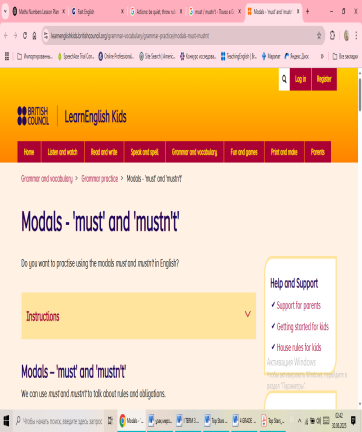
Grammar box poster. https://learnenglishkids.britishcouncil.org/grammar-vocabulary/grammar-practice/modals-must-mustnt
Handouts
Cards
Pictures Poster CD Track 33 | |||||
|
Assessment Criteria:
| |||||||
|
| |||||||
| Homework | |||||||
Создайте Ваш сайт учителя Видеоуроки Олимпиады Вебинары для учителей
Grammar;must/mustn't
Вы уже знаете о суперспособностях современного учителя?


Просмотр содержимого документа
«Grammar;must/mustn't»
| Unit: 2 | My World | ||||||
| Teacher’s name: | Nurbergen.A | ||||||
| Date: | 21.10.26 | ||||||
| Class: 4б | Number present: | Number absent: | |||||
| Theme of the lesson | Grammar: must / mustn’t | ||||||
| Learning objective (s) |
4. 3. 1. 2 recognise, identify, and sound with support a growing range of language at a text level; 4. 4. 2. 1 follow word order rules in more complex statements; 4. 5. 1. 14 use must/mustn’t to talk about obligation.
| ||||||
| Lesson objectives | recognise and identify sounds in key vocabulary use “must/mustn’t” in short phrases to express rules create a classroom rules poster using simple phrases and sentences express immediate classroom needs using basic statements | ||||||
| Values of the lesson | Respecting rules and responsibilities, understanding classroom and community expectations, promoting safety and cooperation. | ||||||
| Plan | |||||||
| Stages of the lesson | Teacher’s activities | Students’ activities | Assessment | Resources
| |||
| Greeting 2 min.
| Begin the lesson with some greetings. Ask and answer: Hello, boys and girls! How are you? | The students greet the teacher. Good morning, good morning to you, W | |||||
| Warm-up 5min
| Recognition exercise. The teacher greets students and starts a short game: “Good or Bad?” – shows a flashcard (e.g., someone throwing rubbish or someone having a shower) and asks, “Is this good or bad?” |
Open Answer |
Observe participation and pronunciation. |
| |||
|
Presentation Vocabulary 6 min
Presentation Grammar 8 min Grammar Practice 10 min
Ending the lesson 6 min
Feedback 3min
| Activity 1. Conveying the meaning of new words. Show and Say (with visuals or miming): Introduce each word with actions or pictures: Be quiet (finger on lips) Throw rubbish (mime throwing paper) Have a shower (mime washing head) Touch (mime touching something gently) Rubbish bin – Show a picture or point to real bin Swimming pool – Show an image Swimming cap – Bring a real cap or show a picture For Ss with special needs: Visual aids. Grammar: must / mustn’t Write two sentences on the board: ✅ You must wear a swimming cap. ❌ You mustn’t run near the pool. Explain that “must” means something is important to do, and “mustn’t” means something is not allowed. Say examples and mime (e.g., must be quiet, mustn’t shout) and ask students to repeat. For Ss with special needs: Use visuals for each rule, provide sentence starters (e.g., We must…, We mustn’t…), and allow gestures or pointing as a response. Activity 2. Read and put Direct Ss’ attention to the pictures of the different places. Have Ss read the phrases underneath the pictures and make sure they understand everything. Explain they have to put ✔ in the box next to the phrases for the things they must do at these places and ✘ for the things they mustn’t do. Allow Ss some time to do this. Activity 3. Listen and read the poster. “Look at the signs in the book. What do you think these rules mean? Tell me using must or mustn’t.” “Now listen to the recording and follow the text with your finger.” “Let’s talk about the museum. What can we do and what can’t we do there?” “Now read the text aloud in pairs.” “Look at the sentence on the board: Tom is a tall boy. What word describes Tom? Write your own sentence with an adjective like big, small, or funny.” For Ss with special needs: Teacher encourages pointing or choosing from multiple choice options rather than open-ended tasks | Students look at the visuals or watch the teacher’s miming. They repeat the words aloud and try to copy the actions or point to matching pictures.
Key: Zoo 1. ✘ 2. ✘ Museum 1. ✔ 2. ✘ 3. ✘ 4. ✘ Classroom 1. ✘ 2. ✔ 3. ✘ 4. ✔ Swimming Pool 1. ✔ 2. ✔ 3. ✘ 4. ✘
Students look at the signs and say what rules they show using must/mustn’t. Then they listen to the recording and follow the text. In pairs, students read the text aloud and make their own short sentences using adjectives to describe people or things. . |
Oral Assessment
Observation through participation and pronunciation
Descriptor: A learner: recognises and pronounces new vocabulary correctly matches words to visuals or mimed actions
Self-Assessment
Descriptor: A learner: uses must/mustn’t correctly recognises which actions are allowed or not allowed.
Observation through students’ ability to correctly match signs with rules and form simple sentences using must/mustn’t and adjectives during pair and class activities.
|
Flashcards CD Track 31
Grammar box poster.
https://learnenglishkids.britishcouncil.org/grammar-vocabulary/grammar-practice/modals-must-mustnt Handouts
Cards Pictures Poster CD Track 33 | |||
| Formative Assessment. Read and write. Put the adjectives in the correct place. Explain to Ss that they have to rewrite each sentence by putting the adjective in brackets in the correct place. Have Ss compare their answers in pairs first, then check as a class. F | Students read each sentence and look at the adjective in brackets. They rewrite the sentence, placing the adjective in the correct position before the noun (e.g., a ball (red) → a red ball). After completing the task, students compare their answers with a partner and discuss any corrections. | Assessment Criteria: places adjective correctly before a noun in a simple sentence-3 demonstrates understanding by accurately rewriting sentences-3 reads and pronounces the words clearly-3 gives constructive feedback to classmate-1
| |||||
| Reflection. There smiley faces are on the board. (happy and sad) T. suggests choosing any smiley face. S | |||||||
| Homework | Go to WB p. 23. Do the project and present it. | ||||||
 e are glad to see you too.
 for what you must do at these places or
 for what you mustn’t do.
 or Ss with special needs: Teacher gives a word bank with visual support for common adjectives.
 s will choose one and put on their desks.
Полезное для учителя


* Свидетельство о публикации выдается БЕСПЛАТНО, СРАЗУ же после добавления Вами Вашей работы на сайт