John Wallis and Richard Mulcaster are one of those who believe that there is a great demand for English from foreigners who want to understand various important works written in our language.
Создайте Ваш сайт учителя Видеоуроки Олимпиады Вебинары для учителей
Why English? The cultural foundation
Вы уже знаете о суперспособностях современного учителя?

Как тратить минимум сил на подготовку и
проведение уроков?

Как быстро и объективно проверять
знания учащихся?

Как сделать изучение нового материала
максимально понятным?

Как избавить себя от подбора заданий и
их проверки после уроков?

Как наладить дисциплину на своих
уроках?

Как получить возможность работать
творчески?
Просмотр содержимого документа
«Why English? The cultural foundation»
Why English? The cultural foundation
John Wallis and Richard Mulcaster are one of those who believe that there is a great demand for English from foreigners who want to understand various important works written in our language. Richard Mulcaster, the headmaster
of Merchant Taylors' School, had been one of the strongest supporters
of the English language, avowing in 1582: «I love Rome, but London better. I favour Italy, but England more. I honor he Latin, but I worshiped English». He always defended the language before those who believed that English should give way to other languages. He says: «I do not think that any language is better able to utter all arguments, either with more pith or greater plainness, as our English tongue is». But at the same time, Mulcaster saw the problem in the fact that the English language did not match the international level.
Later poet Samuel Daniel, traveler Richard Flecknoe and the Earl of Chesterfield will write that English is going through rapid progress and has recently been actively spread across Europe. In 1780 John Adams, as part of his proposal to Congress for an American Academy, expressed the view that English will become a common language from the next century. He was right. In 1851 a German, Jakob Grimm recognized English as a world language. His view was much quoted, and during the nineteenth century similar opinions multiplied as British imperialism grew.
US linguist Richard W. Bailey, in his cultural history of the language, Images of English, in 1829 wrote that English replaces other languages around the world. About 60 million people were speaking English around the world as a mother tongue by the 1850s. And, others were predicting in the 1870s, after a further century the grand total of mother-tongue speakers would almost certainly reach 1,000 million.
Isaac Pitman (is the editor of The Phonetic Journal) writing about how many people will speak English in each of the countries:
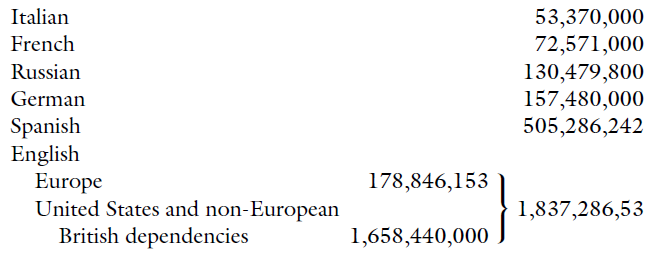
It is also known that English spread throughout the world in a short period of time. The most famous instance, in fact, relating to English itself, in 1066. Within 200 years of the Norman Conquest, the language of England was emerging, in the earliest Middle English literature, as – English, not French. There was no linguistic conquest. Perhaps, if the Normans had taken up residence in larger numbers, or if good political relations between England and France had lasted longer, or if English had not already been so well established since Anglo-Saxon times, the outcome might have been different. This book would then, in all probability, have been written about (and in) World French.








Полезное для учителя




Распродажа видеоуроков!

1860 руб.
2660 руб.

1760 руб.
2510 руб.

1880 руб.
2690 руб.

1880 руб.
2690 руб.
ПОЛУЧИТЕ СВИДЕТЕЛЬСТВО МГНОВЕННО

* Свидетельство о публикации выдается БЕСПЛАТНО, СРАЗУ же после добавления Вами Вашей работы на сайт
Удобный поиск материалов для учителей
Проверка свидетельства